
Suzuki GSX-R 1000 Service Manual: Battery current leakage inspection
Inspect the battery current leakage in the following procedures:
- turn the ignition switch off.
- Remove the front seat. Refer to “exterior parts removal and installation” in section 9d (page 9d- 6).
- Disconnect the battery (–) lead wire.
- Measure the current between battery (–) terminal and the battery (–) lead wire using the multi-circuit tester. If the reading exceeds the specified value, leakage is evident.
Caution
|
Special tool
 (a): 09900–25008 (multi circuit
tester set)
Tester knob indication
current (  , 20 ma)
Battery current (leak) under 3 ma
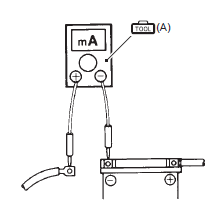
- Connect the battery (–) terminal and install the front seat. Refer to “battery removal and installation” and “exterior parts removal and installation” in section 9d .

 Regulated voltage inspection
Inspect the regulated voltage in the following
procedures:
remove the front seat. Refer to “exterior parts
removal and installation” in section 9d (page 9d-
6).
Start the engine ...
Other materials:
Engine coolant temperature indicator light inspection
Inspect the engine coolant temperature meter and indicator light (led) in the
following procedures:
remove the left side cowling. Refer to “exterior parts removal and
installation” in section 9d .
Disconnect the ect sensor coupler (1).
Connect a variable resistor (2) ...
Drive chain related components
Drive chain
Engine sprocket
Rear sprocket
Dust seal
Bearing
Retainer
Sprocket mounting drum
Wheel damper
145 N·m (14.5 Kgf-m,
105.0 Lbf-ft)
60 N·m
(6.0 Kgf-m, 43.0 Lbf-ft)
Apply grease
Apply thread lock to
thread p ...
Cam chain tensioner inspection
Inspect the cam chain tensioner in the following
procedures:
remove the cam chain tensioner. Refer to “cam chain guide / cam chain
tensioner removal and installation” .
Check the contacting surface of the cam chain
tensioner. If it is worn or damaged, replace it with a
new ...