
Suzuki GSX-R 1000 Owners Manual: Using the transmission
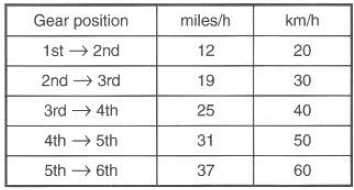
The transmission is provided to keep the engine operating smoothly in its normal operating speed range. The gear ratios have been carefully chosen to meet the characteristics of the engine. The rider should always select the most suitable gear for the prevailing conditions. Never slip the clutch to control road speed, but rather downshift to allow the engine to run within its normal operational range. The table below shows the approximate speed range for each gear.
Shifting up schedule
Shifting down schedule
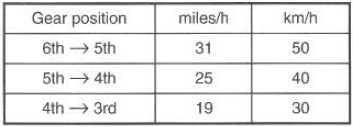
Disengage the clutch when the motorcycle speed drops below 12 miles/h (20 km/h).
 Warning Warning
Reduce speed before downshifting. |
| Warning
Reduce your speed and downshift before entering the corner. |
|
Caution Revving the engine into the red zone can cause severe engine damage. Never allow the engine to rev into the red zone in any gear. |
 Starting off
Warning
Riding this motorcycle at
excessive speed increases
your chances of losing control
of the motorcycle. This may
result in an accident.
Always ride within the limits of
...
 Riding on hills
When climbing steep hills, the
motorcycle may begin to slow
down and show lack of power.
At this point you should shift to
a lower gear so that the engine
will again be operating in its
...
Other materials:
Inspecting the drive chain
When inspecting the chain, look
for the following:
loose pins
damaged rollers
dry or rusted links
kinked or binding links
excessive wear
improper chain adjustment
If you find anything wrong with the
drive chain condition or adjustment,
correct the pr ...
DTC “c21” (p0110-h/l): iat sensor circuit
malfunction
Detected condition and possible cause
Detected condition
Possible cause
C21
Output voltage is not with in the following
range.
0.15 V ≤ Sensor voltage < 4.85 V
Iat sensor circuit open or short.
Iat sensor malfunction.
Ec ...
Engine coolant solution
Use engine coolant that is com·
patible with an aluminum radiator,
mixed with distilled water at a
50:50 mixture ratio for engine
coolant solution. An engine coolant
mixture other than 50:50 can
affect cooling efficiency or rust
inhibiting performance.
Engine coolant
Engine coolant should b ...