
Suzuki GSX-R 1000 Owners Manual: Air cleaner
The air cleaner element must be kept clean to provide good engine power and g1as mileage. If you use your motorcycle under normal low-stress conditions, you should service the air cleaner at the intervals specified. If you ride in dusty, wet, or muddy conditions, you will need to inspect the air cleaner element much more frequently.
Use the following procedure to remove the element and inspect it.
 Warning Warning
Never run the engine without the air cleaner element properly installed. |
|
Caution Clean or replace the air cleaner element frequently if the motorcycle is used in dusty, wet or muddy conditions. The air cleaner element will clog under these conditions, and this may cause engine damage, poor performance, and poor fuel economy. Clean the air cleaner case and element immediately if water gets in the air cleaner box. |
Air cleaner element removal
- Place the motorcycle on the side stand.
- Remove the front seat by referring to the seat lock and helmet holders section.
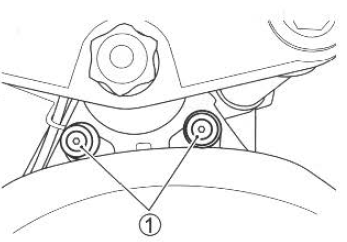
- Remove the fuel tank fitting bolts 3.
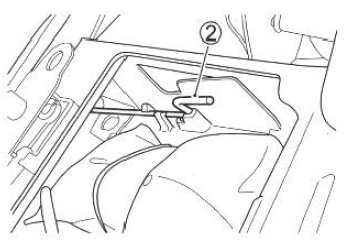
- Remove the prop stay 2.
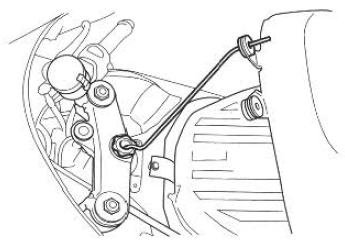
- Lift the front end of the fuel tank and prop it up as shown above. Insert the crank end of the prop stand into the hole of the steering shaft.
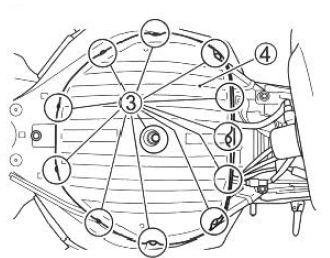
- Remove the 12 screws 3.
- Remove the cover 4.
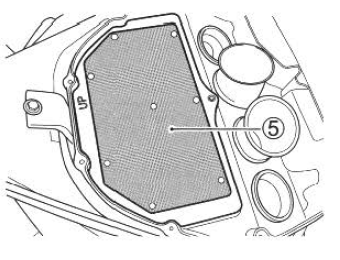
- Remove the air cleaner element 5.
Air cleaner element
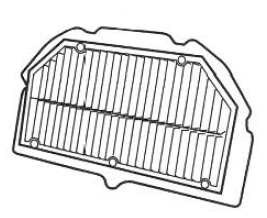
Inspect the air cleaner element condition. Replace the air cleaner element periodically.
Installation
Reinstall the air cleaner element in the reverse order of the removal.
|
Caution A torn air cleaner element will allow dirt to enter the engine and can damage the engine. Carefully examine the air cleaner element for tears during cleaning. Replace it with a new one if it is torn. |
|
Caution Failure to position the air cleaner element properly can allow dirt to bypass the air cleaner element. This will cause engine damage. Be sure to properly install the air cleaner element. |
 Batiery
The battery is located under the
front seat. Remove the front seat
by referring to the seat lock
and helmet holders section.
This battery is sealed type
and requires no maintenance.
Have you ...
 Spark plugs
Your motorcycle comes equipped
with ngk cr9e or denso
u27esr-n spark plugs. To determine
if the standard spark plug is
right for your usage, check the
color of the plug's porcelain center
electr ...
Other materials:
Cushion rod removal and installation
Removal
Remove the right side cowling and side frame covers. Refer to “exterior
parts removal and installation” in section 9d .
Support the motorcycle with a jack to relieve load on
the cushion rod.
Remove the muffler chamber. Refer to “muffler / muffler chamber /
exhaust ...
Camshaft sprocket
Inspect the camshaft sprocket in the following
procedures:
remove the intake and exhaust camshafts. Refer to “engine top side
disassembly” .
Inspect the teeth of each camshaft sprocket for wear
or damage.
If they are worn or damaged, replace the sprocket/
camshaft assembl ...
Sprocket mounting drum dust seal / bearing removal and installation
Removal
Remove the rear wheel assembly. Refer to “rear wheel assembly removal
and installation” in section 2d .
Remove the rear sprocket mounting drum assembly
(1). Refer to “rear sprocket / rear sprocket
mounting drum removal and installation” (page 3a-
3).
Remove the ...