
Suzuki GSX-R 1000 Service Manual: Excva removal and installation
Removal
- Turn the ignition switch off.
- Remove the left side cowling. Refer to “exterior parts removal and installation” in section 9d .
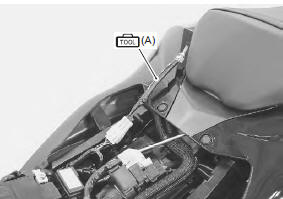
- Connect the special tool (mode select switch) to the dealer mode coupler. Refer to “self-diagnostic procedures” in section 1a .
- After turning the mode select switch on, turn the ignition switch on.
Special tool
 (a): 09930–82720 (mode selection
switch)
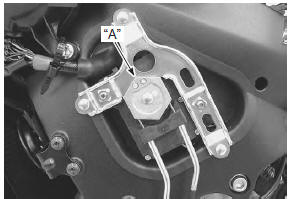
- Check that the cable slots of the excva pulley comes to the middle (adjustment position) “a”.
- Turn the ignition switch off.
| Caution before removing the excva, be sure to set the excva pulley to the adjustment position. |
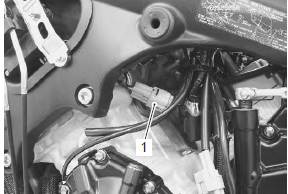
- Disconnect the excva coupler (1).
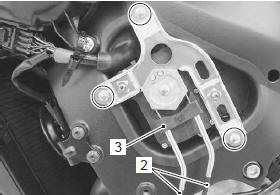
- Remove the excv cables (2). Refer to “excv cable removal and installation” .
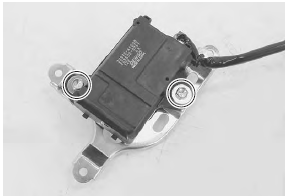
- Remove the excva (3) with the bracket.
- Remove the bracket from the excva
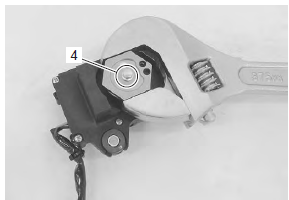
- Hold the pulley with an adjustable wrench, and loosen the pulley mounting bolt (4).
Caution
|
- Remove the pulley from the excva body.
Installation
Install the excva in the reverse order of removal. Pay attention to the following points:
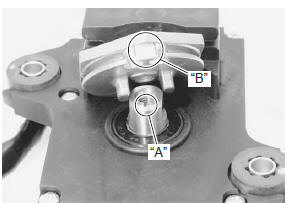
- install the excva pulley to the shaft.
| Note align the shaft’s line “a” and cable slots “b”. |
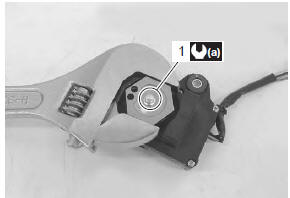
- Hold the pulley with an adjustable wrench, and then tighten the pulley mounting bolt (1) to the specified torque.
Tightening torque excva pulley mounting bolt (a): 5 n·m (0.5 Kgfm, 3.5 Lbf-ft)
| Caution when loosening or tightening the pulley bolt, be sure to fix the pulley with an adjustable wrench, or excva may get damaged. |
- Install the excv cables. Refer to “excv cable removal and installation” .
- Adjust the excva. Refer to “excva adjustment” .
Excva inspection
Refer to “dtc “c46” (p1657-h/l or p1658): excv actuator circuit malfunction” in section 1a (page 1a- 109).
 Excv cable removal and installation
Removal
Turn the ignition switch off.
Remove the front seat. Refer to “exterior parts
removal and installation” in section 9d (page 9d-
6).
Remove the left side cowling. Refer ...
 Excva pulley inspection
Inspect the excva pulley in the following procedures:
remove the excva pulley. Refer to “excv cable removal and installation”
.
Visually inspect the excva pulley for wear and
da ...
Other materials:
Special tools and equipment
Recommended service material
Note
required service material is also described in the following.
“Rear lighting system construction”
Special tool
...
Schematic and routing diagram
Engine lubrication system chart diagram
Engine lubrication circuit diagram
...
Specifications
Tightening torque specifications
Note
the specified tightening torque is described in the following.
“Body frame construction” “front footrest bracket construction”
“side-stand construction”
Reference: for the tightening torque of fastener not specified in this ...