
Suzuki GSX-R 1000 Owners Manual: Tire pressure and loading
Proper tire pressure and proper tire loading are important factors.
Overloading your tires can lead to tire failure and loss of vehicle control.
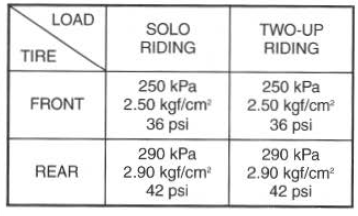
Check tire pressure each day before you ride, and be sure the pressure is correct for the vehicle load according to the table below.
Tire pressure should only be checked and adjusted before riding, since riding will heat up the tires and lead to higher inflation pressure readings.
Under-inflated tires make smooth cornering difficult, and can result in rapid tire wear. Over-inflated tires have a smaller amount of tire in contact with the road, which can contribute to skidding and loss of control.
Note
: when you detect drops in tire pressure, check the tire for nails or other punctures, or a damaged wheel rim. Tubeless tires sometimes lose pressure gradually when punctured.
 Tires
Tires
Warning
Failure to follow these warnings
may result in an accident
due to tire failure. The tires on
your motorcycle form the crucial
link between your motorcycle
and the road ...
 Tire condition and type
Tire condition and tire type affect
motorcycle performance. Cuts or
cracks in the tires can lead to tire
failure and loss of motorcycle
control. Worn tires are susceptible
to puncture failures an ...
Other materials:
DTC “c91” (p0500): vehicle speed sensor
circuit malfunction
Detected condition and possible cause
Detected condition
Possible cause
Speedometer does not receive signal from the vehicle
speed sensor for more than 6 sec. When the motorcycle is
running. Ecm does not receive signal from the vehicle
speed sensor for more than ...
Air cleaner element removal and installation
Removal
Lift and support the fuel tank. Refer to “fuel tank
removal and installation” in section 1g (page 1g-
9).
Remove the air cleaner box cover (1).
Remove the air cleaner element (2).
Installation
Installation is in the reverse order of removal. ...
Ignition switch removal and installation
Removal
Remove the air cleaner box. Refer to “air cleaner box removal and
installation” in section 1d .
Disconnect the ignition switch lead wire coupler (1).
Disconnect the immobilizer lead wire coupler (2).
(For e-02, 19, 24, 51)
Remove the harness clamp (3).
...