
Suzuki GSX-R 1000 Service Manual: General description
Engine coolant description
Caution
|
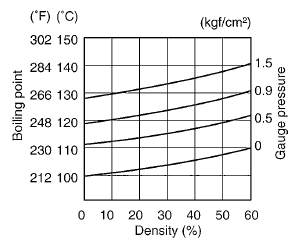
At the time of manufacture, the cooling system is filled with a 50:50 mixture of distilled water and ethylene glycol anti-freeze. This 50:50 mixture will provide the optimum corrosion protection and excellent heat protection, and will protect the cooling system from freezing at temperatures above –31 °c (–24 °f).
If the vehicle is to be exposed to temperatures below – 31 °c (–24 °f), this mixing ratio should be increased up to 55% or 60% according to the figure.
Anti-freeze proportioning chart
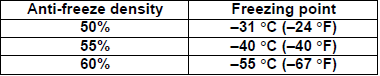
Fig. 1: Engine coolant density-freezing point curve
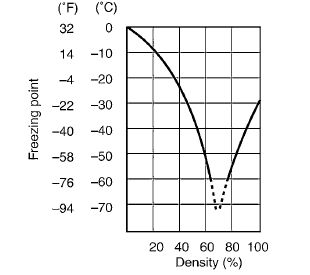
Fig. 2: Engine coolant density-boiling point curve
 Precautions
Precautions for engine cooling system
You can be injured by boiling fluid or steam if you open the
radiator cap when the engine is hot.
After the engine cools, wrap a t ...
 Schematic and routing diagram
Cooling circuit diagram
Water hose routing diagram
Thermostat air bleeder hole
Cushion
O-ring
Radiator heat guard
: be careful not to damage the pawls when ...
Other materials:
Ckp sensor inspection
Refer to “electrical components location” in section 0a .
Ckp sensor peak voltage
Lift and support the fuel tank. Refer to “fuel tank
removal and installation” in section 1g (page 1g-
9).
Disconnect the ckp sensor coupler (1).
Note
be sure that all of the couplers are connect ...
Injection timing description
Injection time (injection volume)
The factors to determine the injection time include the basic fuel injection
time, which is calculated on the basis of the
intake air pressure, engine speed and throttle opening angle, and various
compensations. These compensations are
determined according to ...
Muffler / muffler chamber / exhaust pipe
removal and installation
Removal
Loosen the muffler connecting bolts (1).
Remove the mufflers (2) by removing the mounting
bolt and nut (3).
Note
support the muffler to prevent it from falling.
Remove the side cowlings. Refer to “exterior parts
removal and installation” in secti ...