
Suzuki GSX-R 1000 Service Manual: Ckp sensor inspection
Refer to “electrical components location” in section 0a .
Ckp sensor peak voltage
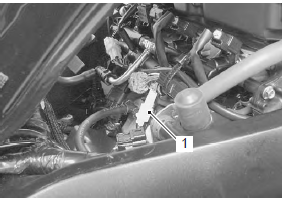
- Lift and support the fuel tank. Refer to “fuel tank removal and installation” in section 1g (page 1g- 9).
- Disconnect the ckp sensor coupler (1).
| Note be sure that all of the couplers are connected properly and the battery is fully-charged. |
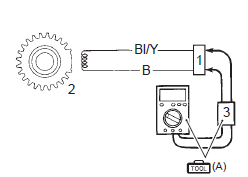
- Connect the multi-circuit tester with the peak volt adaptor as follows.
| Caution before using the multi-circuit tester and peak voltage adaptor, refer to the appropriate instruction manual. |
Special tool
 (a): 09900–25008 (multi circuit
tester set)
Tester knob indication: voltage (
 )
)

|
- Measure the ckp sensor peak voltage in the following procedures:
- Shift the transmission into neutral, turn the ignition switch on and grasp the clutch lever.
- press the starter button and allow the engine to crank for a few seconds, and then measure the ckp sensor peak voltage.
- Repeat the b) procedure several times and measure the highest ckp sensor peak voltage.
Ckp sensor peak voltage 0.5 V and more (b – bl/y)
- If the peak voltage is within the specification, check the continuity between the ckp sensor coupler and ecm coupler.
| Caution normally, use the needle pointed probe to the backside of the lead wire coupler to prevent the terminal bend and terminal alignment. |
- After measuring the ckp sensor peak voltage, connect the ckp sensor coupler.
Ckp sensor resistance
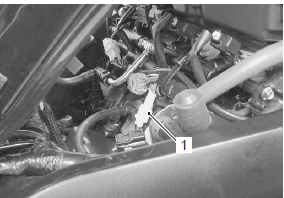
- Lift and support the fuel tank. Refer to “fuel tank removal and installation” in section 1g (page 1g- 9).
- Disconnect the ckp sensor coupler (1).
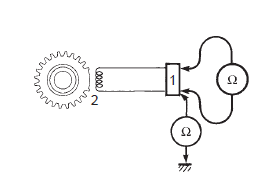
- Measure the resistance between the lead wires and
ground. If the resistance is not within the standard
range, replace the ckp sensor with a new one.
Refer to “ckp sensor removal and installation” .
Tester knob indication resistance (Ω)
Ckp sensor resistance 142 . 194 Ω¶ (B . Bl/y) ∞Ω¶ (b . Ground)
|
- After measuring the ckp sensor resistance, connect the ckp sensor coupler.
- Reinstall the fuel tank. Refer to “fuel tank removal and installation” in section 1g .
Ckp sensor removal and installation
Refer to “generator removal and installation” in section 1j .
 Ignition coil inspection
Refer to “electrical components location” in section 0a .
Ignition coil primary peak voltage
Remove the air cleaner box. Refer to “air cleaner box removal and
installation” in section 1d .
D ...
 Engine stop switch inspection
Inspect the engine stop switch in the following
procedures:
turn the ignition switch off.
Remove the air cleaner box. Refer to “air cleaner box removal and
installation” in secti ...
Other materials:
Front footrest bracket construction
Footrest bracket bolt
Rear brake master cylinder mounting bolt
Footrest guard bolt
Footrest bracket no. 1 (Lh)
Footrest bracket no. 1 (Rh)
Footrest
Footrest holder
Rear brake pedal
Footrest bracket no. 2 (Lh)
Footrest bracket no. 2 (Rh)
Ban ...
Gearshift lever construction
Gearshift lever bracket
Gearshift lever shaft
Washer
Snap ring
Gearshift lever
Footrest top surface
65 – 75 Mm (2.6 – 3.0 In)
28 N·m (2.8 Kgf-m,
20.0 Lbf-ft)
40 N·m
(4.0 Kgf-m, 29.0 Lbf-ft)
Apply grease.
Grease.
...
Swingarm removal and installation
Removal
Cut the drive chain. Refer to “drive chain replacement” in section 3a .
Remove the rear wheel assembly. Refer to “rear wheel assembly removal
and installation” in section 2d .
Disconnect the rear brake hose from the brake hose
clamp (1).
Remove the brake ho ...