
Suzuki GSX-R 1000 Service Manual: Rear shock absorber disposal
Refer to “rear shock absorber removal and installation” .
The rear shock absorber unit contains high-pressure nitrogen gas.

|
Gas pressure release
Make sure to observe the following precautions:
|
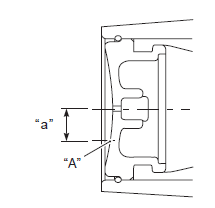
- Mark the drill center at the location “a” using a center punch.
|
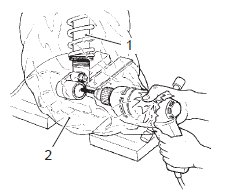
- Wrap rear shock absorber (1) with a plastic bag (2) and fix it on a vise as shown in the figure.
- Drill a 2 – 3 mm (0.08 – 0.12 In) hole at the marked drill center using a drilling machine and let out gas while taking care not to get the plastic bag entangled with the drill bit.
|
 Rear shock absorber adjustment
After installing the rear suspension, adjust the spring
pre-load and damping force as follows:
Spring pre-load adjustment
The set length 179.3 Mm (7.06 In) provides the
maximum spring pre-load ...
 Cushion lever removal and installation
Removal
Remove the right side cowling and side frame covers. Refer to “exterior
parts removal and installation” in section 9d .
Support the motorcycle with a jack to relieve load on
t ...
Other materials:
Tire condition and type
Tire condition and tire type affect
motorcycle performance. Cuts or
cracks in the tires can lead to tire
failure and loss of motorcycle
control. Worn tires are susceptible
to puncture failures and subsequent
loss of motorcycle control.
Tire wear also affects the tire profile,
changing moto ...
General description
Fuel injection system description
Fuel system
The fuel delivery system consists of the fuel tank (1), fuel pump (2), fuel
filter (3), fuel feed hose (4), fuel delivery pipes
(5) including fuel injectors (6) and (7), fuel pressure regulator (8). There is
no fuel return hose. The fuel in the fu ...
Pillion footrest construction
Pillion footrest
Spring
Ball
E-ring
Washer
O-ring
Footrest pin
Apply grease.
Do not reuse.
...