
Suzuki GSX-R 1000 Service Manual: Diagnostic information and procedures
Engine mechanical symptom diagnosis
Refer to “engine symptom diagnosis” in section 1a .
Compression pressure check
The compression pressure reading of a cylinder is a good indicator of its internal condition.
The decision to overhaul the cylinder is often based on the results of a compression test. Periodic maintenance records kept at your dealership should include compression readings for each maintenance service.
Note
|
- Warm up the engine.
- Lift and support the fuel tank. Refer to “fuel tank removal and installation” in section 1g (page 1g- 9).
- Remove the air cleaner box. Refer to “air cleaner box removal and installation” .
- Remove all the spark plugs. Refer to “ignition coil and spark plug removal and installation” in section 1h .
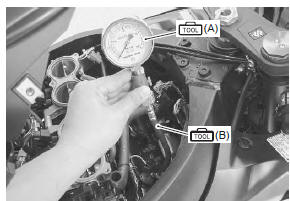
- Install the compression gauge and adaptor in the spark plug hole. Make sure that the connection is tight.
Special tool
 (a): 09915–64512 (compression
gauge)
 (b): 09915–63311 (compression gauge
attachment)
- Keep the throttle grip in the fully-opened position.
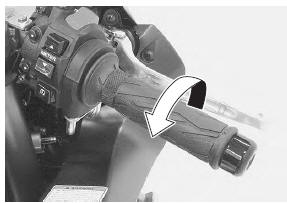
- Press the starter button and crank the engine for a few seconds. Record the maximum gauge reading as the cylinder compression.
- Repeat this procedure with the other cylinders.
Compression pressure specification
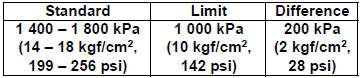
Low compression pressure can indicate any of the following conditions:
- excessively worn cylinder walls
- worn piston or piston rings
- piston rings stuck in grooves
- poor valve seating
- ruptured or otherwise defective cylinder head gasket
Overhaul the engine in the following cases:
- compression pressure in one of the cylinders is 1 000 kpa (10 kgf/cm2, 142 psi) and less.
- The difference in compression pressure between any two cylinders is 200 kpa (2 kgf/cm2, 28 psi) and more.
- All compression pressure readings are below 1 400 kpa (14 kgf/cm2, 199 psi) even when they measure 1 000 kpa (10 kgf/cm2, 142 psi) and more.
- After checking the compression pressure, reinstall the removed parts.
 Throttle cable routing diagram
Throttle cable no. 1
Throttle cable no. 2
Clutch cablev
Front brake hose
Pass
the throttle cables in front of the front brake hose.
Pass the
clutch ca ...

Other materials:
Helmet holders
This motorcycle has helmet holders
underneath the rear seat.
Hook your helmet on the helmet holder and lock the seat.
Warning
Riding with a helmet fastened
to the helmet holder can interfere
with rider control.
Never carry a helmet fastened
to the helmet holder. Fix the
...
Starter motor will not run
Note
make sure the fuses are not blown and the battery is fully-charged
before diagnosing.
Troubleshooting
Step
Action
Yes
No
1
Shift the transmission into neutral.
Grasp the clutch lever, turn on the ignition switch ...
Break-in procedures
During manufacture only the best possible materials are
used and all machined parts are finished to a very high
standard but it is still necessary to allow the moving parts
to “break-in” before subjecting the engine to maximum
stresses. The future performance and reliability of the
engine depen ...