
Suzuki GSX-R 1000 Service Manual: Rear brake caliper parts inspection
Refer to “rear brake caliper disassembly and assembly” .
Brake caliper cylinder
Inspect the brake caliper cylinder wall for nicks, scratches or other damage. If any damage is found, replace the caliper with a new one.
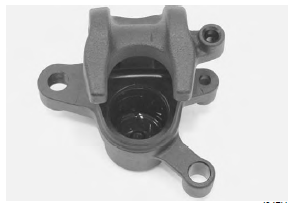
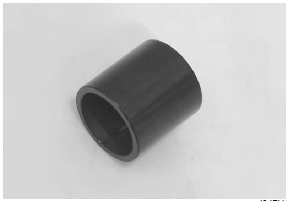
Brake caliper piston
Inspect the brake caliper piston surface for any scratches or other damage. If any damage is found, replace the piston with a new one.
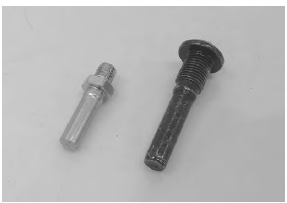
Brake caliper sliding pin
Inspect the brake caliper sliding pins for wear and other damage. If any damage is found, replace the sliding pin with a new one.
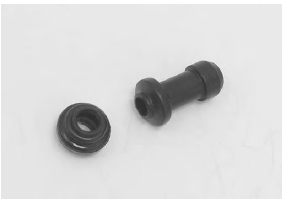
Boot
Inspect the boots for damage and wear. If any defects are found, replace it with a new one.
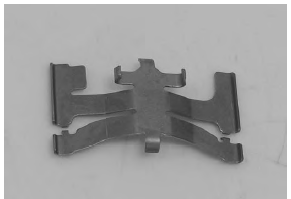
Brake pad spring
Inspect the brake pad spring for damage and excessive bend. If any defects are found, replace it with a new one.
 Rear brake caliper disassembly and
assembly
Rear brake caliper disassembly and
assembly
Refer to “rear brake caliper removal and installation” .
Disassembly
Remove the pad spring (1) and rubber boot (2) from
the caliper.
Place a rag over the piston to prevent it from pop ...
 Rear brake disc removal and installation
Removal
Remove the rear wheel assembly. Refer to “rear wheel assembly removal
and installation” in section 2d .
Remove the rear brake disc.
Installation
Install the rear brake d ...
Other materials:
If a collision is imminent, do something
Many riders fear locking up their
brakes or haven't learned to
swerve to avoid an accident.
Many inexperienced riders (and
too many seasoned riders) use
only their rear brake in an emergency,
resulting in unnecessary
impacts in some cases and
unnecessarily high impact speeds
in other case ...
Brake fluid replacement
Caution
handle brake fluid with care: the fluid reacts
chemically with paint, plastic, rubber
materials, etc.
Front brake
Place the motorcycle on a level surface and keep the
handlebars straight.
Remove the brake fluid reservoir cap and
diaphragm.
Suck u ...
Regulated voltage inspection
Inspect the regulated voltage in the following
procedures:
remove the front seat. Refer to “exterior parts
removal and installation” in section 9d (page 9d-
6).
Start the engine and keep it running at 5 000 r/min
with the dimmer switch turned hi position.
Measure the dc vo ...