
Suzuki GSX-R 1000 Service Manual: Swingarm removal and installation
Removal
- Cut the drive chain. Refer to “drive chain replacement” in section 3a .
- Remove the rear wheel assembly. Refer to “rear wheel assembly removal and installation” in section 2d .
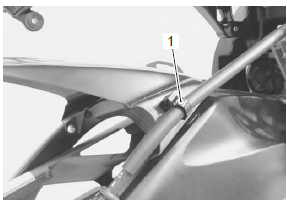
- Disconnect the rear brake hose from the brake hose clamp (1).
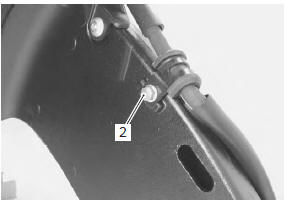
- Remove the brake hose clamp bolt (2).
- Remove the rear brake caliper from the swingarm.
- Remove the left muffler and muffler chamber heat guard no. 2. Refer to “muffler / muffler chamber / exhaust pipe removal and installation” in section 1k .
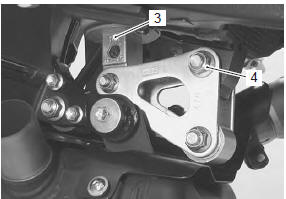
- Remove the rear shock absorber (3) and cushion lever mounting bolt and nut (4). Refer to “rear shock absorber removal and installation” and “cushion lever removal and installation” .
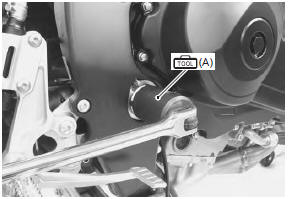
- Remove the swingarm pivot shaft lock-nut with the special tool.
Special tool
 (a): 09940–14940 (swingarm pivot
thrust
adjuster wrench)
- Hold the swingarm pivot shaft (5) with the special tool and remove the swingarm pivot nut (6).
Special tool
 (b): 09944–28321 (hexagon socket
(19
mm))
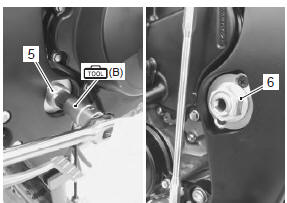
- Remove the swingarm pivot shaft.
- Remove the swingarm assembly.
- Remove the mudguard (7), chain case (8) and chain buffer (9) from the swingarm.
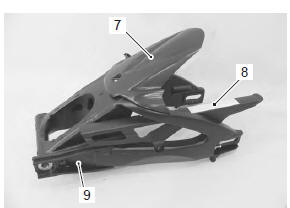
- Remove the plate (10).
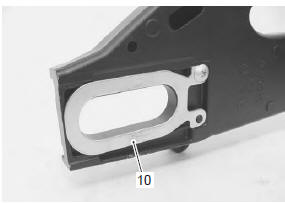
Installation
Install the swingarm in the reverse order of removal. Pay attention to the following points:
- install the plate.
| Note when reusing the removed screw (1), apply a small quantity of the thread lock to it. |
 : Thread lock cement
99000–32110
(thread lock cement super “1322” or
equivalent)
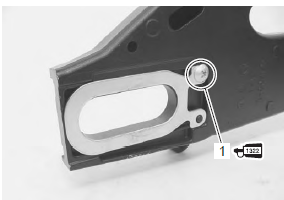
- Adjust swingarm pivot thrust clearance in the following procedures:
– insert the swingarm pivot shaft (2) and tighten it to the specified torque with the special tool.
Special tool
 (a): 09944–28321 (hexagon socket
(19
mm))
Tightening torque swingarm pivot shaft (a): 15 n·m (1.5 Kgf-m, 11.0 Lbf-ft)
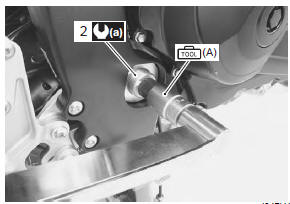
– Hold the swingarm pivot shaft with the special tool and tighten the swingarm pivot nut (3) to the specified torque.
Special tool
 (a): 09944–28321 (hexagon socket
(19
mm))
Tightening torque swingarm pivot nut (b): 100 n·m (10.0 Kgf-m, 72.5 Lbf-ft)
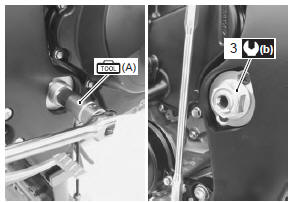
– Tighten the swingarm pivot lock-nut (4) to the specified torque with the special tool.
Special tool
 (b): 09940–14940 (swingarm pivot
thrust
adjuster wrench)
Tightening torque swingarm pivot lock-nut (c): 90 n·m (9.0 Kgfm, 65.0 Lbf-ft)
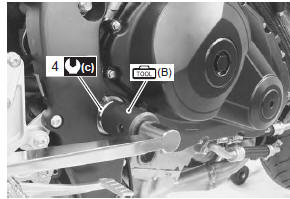
- Tighten the cushion lever, cushion rod and rear shock absorber mounting bolts and nuts to the specified torque.
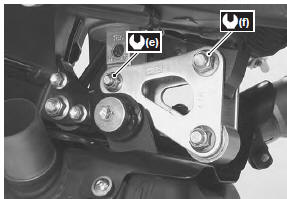
Tightening torque rear shock absorber upper mounting nut (d): 50 n·m (5.0 Kgf-m, 36.0 Lbf-ft) rear shock absorber lower mounting nut (e): 50 n·m (5.0 Kgf-m, 36.0 Lbf-ft) cushion lever mounting nut (f): 98 n·m (9.8 Kgfm, 71.0 Lbf-ft)
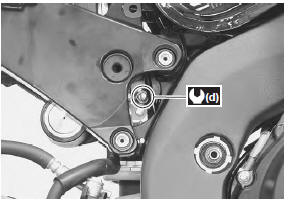
 Cushion rod bearing removal and installation
Removal
Remove the cushion rod. Refer to “cushion rod removal and installation”
.
Remove the cushion rod bearing with the special
tool.
Special tool
(a):
09921–20240 (bearing re ...
 Swingarm pivot boss removal and installation
Removal
Remove the swingarm. Refer to “swingarm removal and installation” .
Remove the swingarm pivot boss nut (1).
Note
remove the swingarm pivot boss only when
replacing ...
Other materials:
Headlight bulb and position light bulb
replacement
Caution
when you touch the bulb with your bare
hands, clean the bulb with a cloth moistened
with alcohol or soap water to prevent
premature bulb failure.
Low beam bulb
Remove the combination meter. Refer to “combination meter removal and
installation” in section 9c .
...
Lubrication points
Proper lubrication is important for smooth operation and long life of each
working part of the motorcycle.
Major lubrication points are indicated as follows.
Note
before lubricating each part, clean off any rusty spots
and wipe off any grease, oil, dirt or grime.
&nbs ...
Evaporative emission control system
inspection (only for e-33)
Refer to “evaporative emission control system removal and installation (only
for e-33)” .
Hose
Inspect the hoses for wear or damage. If it is worn or
damage, replace the hose with a new one.
Note
make sure that the hoses are securely
connected.
Evap canister
Inspect the eva ...